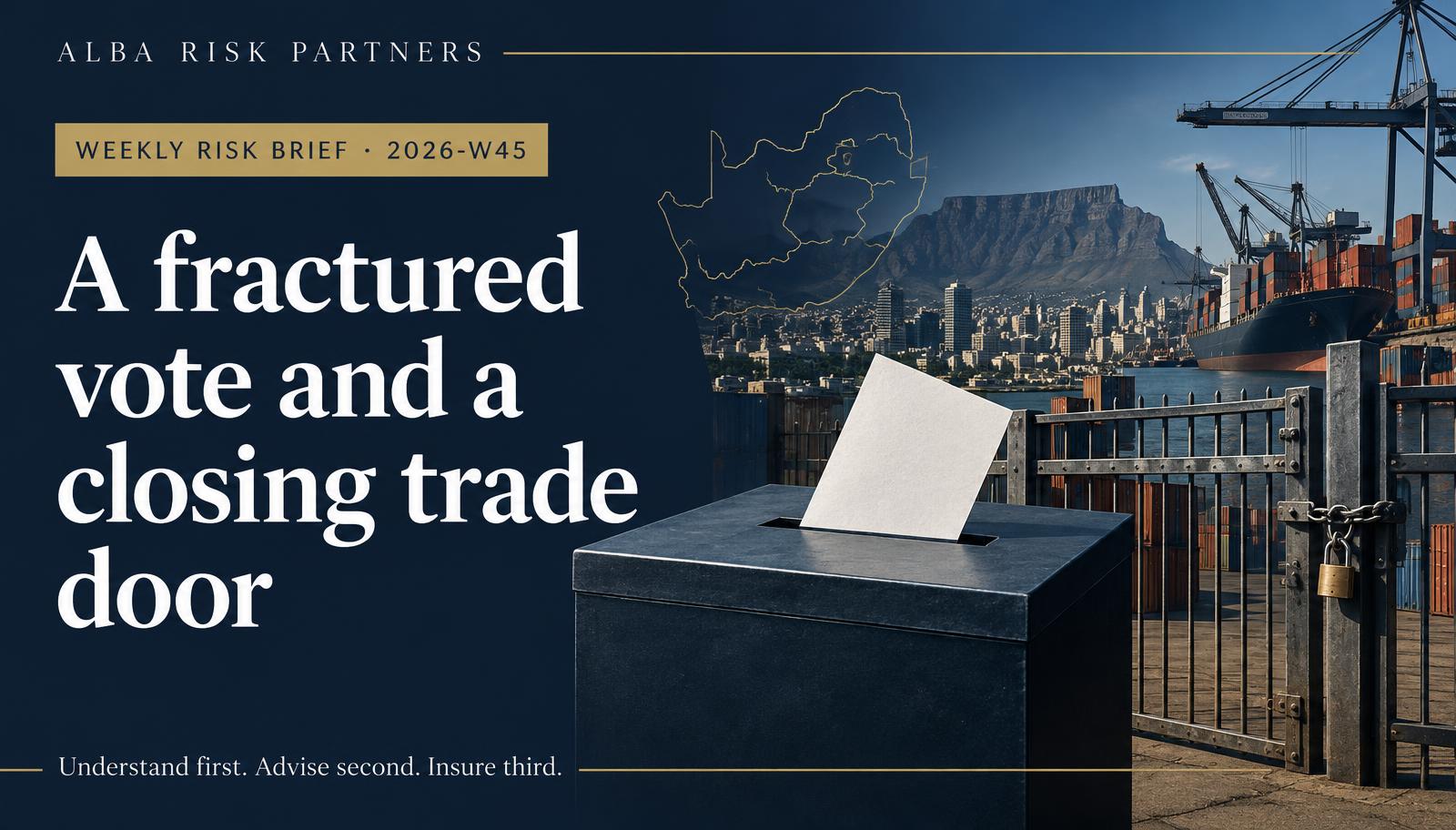
A fractured vote and a closing trade door
Steyn Mc Dowall · 9 November 2026
Voters have handed most of the big cities to coalitions that do not yet exist, in the same week that Washington confirmed the end of duty-free access. The next five years of municipal delivery will be negotiated, not won.
Each risk is classified by severity, reach and onset, with its direction of travel and risk transfer position.
The view ahead
Voters have handed most of the big cities to coalitions that do not yet exist, in the same week that Washington confirmed the end of duty-free access. The next five years of municipal delivery will be negotiated, not won.
The 4 November local government election has redrawn the map of urban power. With about two-thirds of voting districts counted, the ANC held 31.7 percent of the national vote and the DA 25.1 percent, and later counts reported in the press show the gap holding. The DA leads in Johannesburg, Tshwane, Ekurhuleni, Cape Town and Nelson Mandela Bay, the MK Party leads eThekwini with 44.4 percent, and more than 100 municipalities could need coalitions. Results remain provisional while the electoral commission works through more than 800 complaints and recount requests in KwaZulu-Natal. Both main parties have pulled coalition talks under national control to avoid unstable local deals. The incoming councils inherit severe water losses, high unemployment and, in Johannesburg, a R10.3 billion wage agreement signed hours before the vote.
We expect coalition formation to dominate the rest of November and the first quarter of 2027, and we expect the quality of those agreements to decide whether services improve or decay further. Johannesburg, Tshwane and eThekwini carry the most risk, because their water systems are failing and their finances are weakest. The confirmed loss of Agoa from 1 January 2027 will cost less than feared overall, since only about 1 percent of exports used it, but it lands on vehicles, citrus and wine, and it arrives as consumers report the tightest finances in a year. Fuel relief has been almost wholly absorbed by higher oil prices and a weaker rand, electricity output is falling, and public clinics face record medicine shortages. Clients with operations in the metros, exports to the United States or staff reliant on public health care will feel these pressures first.
Risks at a glance
Severity is how hard the risk lands. Reach is how far it travels: contained to one sector, connected across several, or systemic across the economy. Onset is how soon it arrives: immediate, building over coming months, or long-range. Nothing this week is rated severe.
| Risk | Severity | Reach | Onset | Direction |
|---|---|---|---|---|
| POL-01Hung metros and coalition government | Major | Connected | Immediate | Rising |
| HLT-01Record public-sector medicine shortages | Major | Connected | Immediate | Rising |
| MAC-01Fuel relief absorbed by oil and the rand | Major | Systemic | Immediate | Rising |
| POL-05eThekwini and KwaZulu-Natal after the vote | Moderate | Connected | Immediate | Rising |
| ECO-05Household financial strain | Moderate | Systemic | Immediate | Rising |
| ENE-03Falling electricity output and cost | Moderate | Systemic | Building | Rising |
| INF-04Gauteng water supply failure | Moderate | Connected | Immediate | Rising |
| GEO-01Loss of Agoa from January 2027 | Moderate | Connected | Building | Stable |
| GOV-02Procurement challenges and asset recovery | Moderate | Connected | Building | Stable |
| GOV-14Johannesburg wage deal and city finances | Moderate | Contained | Building | Stable |
| CLI-04Climate policy and the mining transition | Minor | Connected | Long-range | Stable |
| REG-05Walvis Bay as a regional fuel hub | Minor | Connected | Long-range | Stable |
Dates that will move the picture
- Mid-Nov
- Electoral commission declares results after objectionsPOL-01
- 9 to 20 Nov
- COP31 climate conference in AntalyaCLI-04
- Late Nov
- First council sittings elect mayors and speakersPOL-01
- 1 Dec
- Full fuel levy relief ends, smaller cuts continueMAC-01
- 1 Jan 2027
- South Africa's Agoa eligibility endsGEO-01
- 5 Jan 2027
- Remaining fuel levy relief endsMAC-01
- 2027
- Minister reconsiders lottery licence under suspended orderGOV-02
- Apr 2028
- China's two-year zero-tariff window for African goods closesGEO-01
- Mid-2028
- Walvis Bay fuel storage and pipeline due for completionREG-05
Opportunities worth watching
Zero tariffs in China. Exports to China rose 24 percent between May and August after Beijing removed tariffs on qualifying African goods, with agricultural exports up more than 35 percent.
A reset with Washington. The President expects a Democratic Congress to help repair relations and has called for talks on a bilateral trade agreement to replace Agoa.
Smelters back on line. Two ferrochrome smelters are restarting after new Eskom pricing agreements, showing that negotiated tariffs can bring energy-intensive processing back.
Natural diamond demand. Botswana reports rising demand for natural diamonds in the United States and India, which supports regional mining suppliers and payment flows.
Risk register
Each card carries the risk, its category, severity, reach, onset, direction of travel and risk transfer position, together with the response we recommend.
- Insurable
- Three blocks. Cover readily placed in the local market.
- Partially insurable
- Two blocks. Cover available for part of the exposure, locally or internationally, with material exclusions.
- Not insurable
- One block. No insurance market responds. The exposure is managed, hedged or retained.
Major severity
POL-01
Hung metros and coalition government
- Category
- Political
- Severity
- Major
- Reach
- Connected
- Onset
- Immediate
- Direction
- Rising
- Insurance
- Partially insurable
With two-thirds of districts counted, the ANC had 31.7 percent and the DA 25.1 percent, and more than 100 municipalities could need coalitions. The DA leads five metros and the MK Party eThekwini. Both main parties have centralised coalition talks to avoid unstable deals. Results are provisional until objections are resolved, and most large metros will need agreements to govern.
What we recommend
Map which councils govern your key sites and plan for slower decisions while coalitions form. Build service and permit delays into first-quarter 2027 plans.
HLT-01
Record public-sector medicine shortages
- Category
- Health
- Severity
- Major
- Reach
- Connected
- Onset
- Immediate
- Direction
- Rising
- Insurance
- Partially insurable
More than one in seven medicines on the Health Department's master list are at risk of running out, with critical shortages of 165 products, including cancer and psychiatric drugs. Patients are buying treatment privately. Causes include global supply disruption, unpaid state bills, local manufacturers missing regulatory standards and weaknesses in the tender system, so recovery will be slow.
What we recommend
Employers should check how staff on chronic treatment through public clinics are affected and support access where needed. Healthcare suppliers should review stock and payment exposure to the state.
MAC-01
Fuel relief absorbed by oil and the rand
- Category
- Macro and energy
- Severity
- Major
- Reach
- Systemic
- Onset
- Immediate
- Direction
- Rising
- Insurance
- Not insurable
Petrol fell by only one cent a litre in November despite the R1.50 levy cut, while diesel fell by R1.10 to R1.20. Brent crude rose from $101 to $108 a barrel over the review period on Middle East tensions, and the rand weakened, offsetting most of the R10 billion relief. Full relief ends on 1 December and the rest on 5 January, so prices could rise sharply in January.
What we recommend
Keep hedges and fuel escalation clauses in place and do not budget on the levy cut. Model margins for a January price rise when relief ends.
Moderate severity
POL-05
eThekwini and KwaZulu-Natal after the vote
- Category
- Political
- Severity
- Moderate
- Reach
- Connected
- Onset
- Immediate
- Direction
- Rising
- Insurance
- Partially insurable
The MK Party leads eThekwini with 44.4 percent, short of a majority, so the metro that hosts the country's main port faces coalition talks. The electoral commission is investigating recount calls in parts of KwaZulu-Natal, where counting restarted at some stations. eThekwini loses more than half its water, and murder remains high in Durban. Disputes over the count are untested.
What we recommend
Prepare for a period of uncertain governance in eThekwini and review port, logistics and water continuity plans for Durban. Confirm riot cover and the Sasria excess.
ECO-05
Household financial strain
- Category
- Economy
- Severity
- Moderate
- Reach
- Systemic
- Onset
- Immediate
- Direction
- Rising
- Insurance
- Not insurable
NielsenIQ finds 41 percent of consumers feel worse off than a year ago, up from 37 percent, while only 38 percent feel better off. Food prices top the list of concerns, followed by utilities and transport. More than four in ten have stopped buying some products, many are switching to discount retailers, and one in four may borrow more, which raises credit risk heading into the festive season.
What we recommend
Consumer-facing clients should plan for trading down through the festive season. Lenders and retailers should tighten credit criteria and collections.
ENE-03
Falling electricity output and cost
- Category
- Energy
- Severity
- Moderate
- Reach
- Systemic
- Onset
- Building
- Direction
- Rising
- Insurance
- Not insurable
Electricity production fell 5.2 percent in September from a year earlier while consumption rose 1.5 percent, and output for the first nine months was 6.9 percent lower. Imports rose 78.4 percent. Government plans 102GW of new capacity, 60 percent renewable, but that is a long-range answer. A widening gap between supply and demand raises the risk of renewed load reduction and higher prices.
What we recommend
Test continuity plans against a return of supply interruptions. Pursue own generation, storage and negotiated tariffs before peak summer demand.
INF-04
Gauteng water supply failure
- Category
- Infrastructure
- Severity
- Moderate
- Reach
- Connected
- Onset
- Immediate
- Direction
- Rising
- Insurance
- Partially insurable
Johannesburg's reservoirs cannot recover under high demand, causing low pressure and outages from Sandton and Midrand to Soweto, and the city is throttling supply. The Human Rights Commission says Gauteng's outages stem from failed maintenance, not shortage, and warns that tanker contracts invite corruption. Tshwane spent R326 million on tankers in 2025/26 while losing water worth R1.7 billion a year.
What we recommend
Install or confirm on-site storage at Gauteng sites and agree contingency supply. Record outage durations to support any claim or rates dispute.
GEO-01
Loss of Agoa from January 2027
- Category
- Geopolitical
- Severity
- Moderate
- Reach
- Connected
- Onset
- Building
- Direction
- Stable
- Insurance
- Not insurable
Washington will end South Africa's Agoa eligibility from 1 January 2027, citing trade barriers, corruption and foreign policy. Agoa exports fell to about R28 billion in 2025, roughly 1 percent of all exports, so economists expect a limited national effect. The cost falls on vehicles, citrus and wine; vehicle exports to the US had already dropped 83 percent under 25 percent tariffs.
What we recommend
Reprice 2027 United States contracts at full tariffs and add adjustment clauses now. Use the Chinese zero-tariff window and other markets to diversify before January.
GOV-02
Procurement challenges and asset recovery
- Category
- Governance
- Severity
- Moderate
- Reach
- Connected
- Onset
- Building
- Direction
- Stable
- Insurance
- Partially insurable
The High Court has set aside the National Lottery licence because a ministerial committee reassessed bids outside the tender process, though it made no adverse finding against the winner and suspended the order to protect operations. Separately, a court ordered former Bosasa executive Angelo Agrizzi to pay the state R1.67 billion; he intends to appeal. Both show courts reopening state awards.
What we recommend
Treat any state award as open to review until the process is shown to be clean, and keep full bid records. Price challenge risk into public-sector contracts.
GOV-14
Johannesburg wage deal and city finances
- Category
- Governance
- Severity
- Moderate
- Reach
- Contained
- Onset
- Building
- Direction
- Stable
- Insurance
- Not insurable
Johannesburg signed a R10.3 billion wage agreement with Samwu hours before the vote, despite the Finance Minister forbidding it and a failed DA court bid. R1.2 billion has already been paid to about 37 000 workers. The deal binds the incoming administration, whoever governs, and may crowd out maintenance and infrastructure spending in a city already short of funds.
What we recommend
Suppliers to Johannesburg should tighten payment terms and watch for delays. Expect pressure on rates and tariffs as the city seeks revenue.
Minor severity
CLI-04
Climate policy and the mining transition
- Category
- Climate
- Severity
- Minor
- Reach
- Connected
- Onset
- Long-range
- Direction
- Stable
- Insurance
- Not insurable
The Minerals Council wants climate policy to encourage mining investment and to let companies set their own route to net zero, balancing decarbonisation with energy security and competitiveness. It published its position ahead of COP31 in Antalya from 9 to 20 November. The outcome will shape carbon pricing and disclosure expectations for mining and its suppliers over years, not months.
What we recommend
Mining and heavy industrial clients should keep transition plans and emissions data current. Track COP31 outcomes for changes in disclosure and financing terms.
REG-05
Walvis Bay as a regional fuel hub
- Category
- Regional
- Severity
- Minor
- Reach
- Connected
- Onset
- Long-range
- Direction
- Stable
- Insurance
- Not insurable
The Dangote group has launched a $2.5 billion fuel storage and pipeline project at Walvis Bay, with about 600 million litres of storage, eight times Namibia's current national capacity. Due within 18 to 20 months, it aims to supply six countries. The project could redirect regional fuel flows away from South African ports and suppliers, though delivery on that timetable is not assured.
What we recommend
Fuel distributors and logistics firms serving neighbouring states should assess how a Walvis Bay hub would affect their routes and pricing. Explore supply or partnership options.
Where insurance carries the load
This week's register leans towards the balance sheet: no risk is rated fully insurable, five sit in the middle and seven fall outside any market. Sasria remains the sole route for riot and public disorder losses, and the disputed counts in KwaZulu-Natal and coalition deadlock in the metros are the triggers to watch. Infectious-disease and supply-chain extensions do not answer medicine shortages; group health cover and medical schemes meet treatment costs only where medicines can be found. A utilities extension answers a physical failure of supply, but throttling, low pressure and intermittent supply in Johannesburg and Tshwane may fall below the threshold or outside the wording. Directors and officers, legal expenses and fidelity cover answer defence costs and employee dishonesty where clients are drawn into procurement disputes, while confiscation orders and fines remain uninsurable, because cover for a penalty offends public policy.
For Agoa, exporters should reprice United States contracts at full most-favoured-nation tariffs from 1 January, build adjustment clauses into supply agreements and use the two-year Chinese zero-tariff window to open alternative markets. For fuel, the lesson of November is that a levy cut does not guarantee a lower price, so hedges and escalation clauses should stay in place through the 5 January expiry. Falling electricity output calls for own generation, storage and negotiated tariffs of the kind that brought the ferrochrome smelters back. Household strain and the Johannesburg wage settlement call for tighter credit terms with consumer-facing customers and the city, and for pricing that assumes trading down continues. Climate policy and the Walvis Bay fuel hub are slower exposures, best handled in strategy and supply contracts rather than in cover. Where an exposure is retained deliberately, consider alternative risk transfer mechanisms to ring-fence a funded reserve, though fines stay outside it and the structure should be tested with a broker first.
Severity: severe, major, moderate, minor, limited. Reach: contained, connected, systemic. Onset: immediate, building, long-range. Ratings are analyst judgements. Matters before the courts are allegations until determined. This brief is general information and not advice on any specific decision.
Share this article