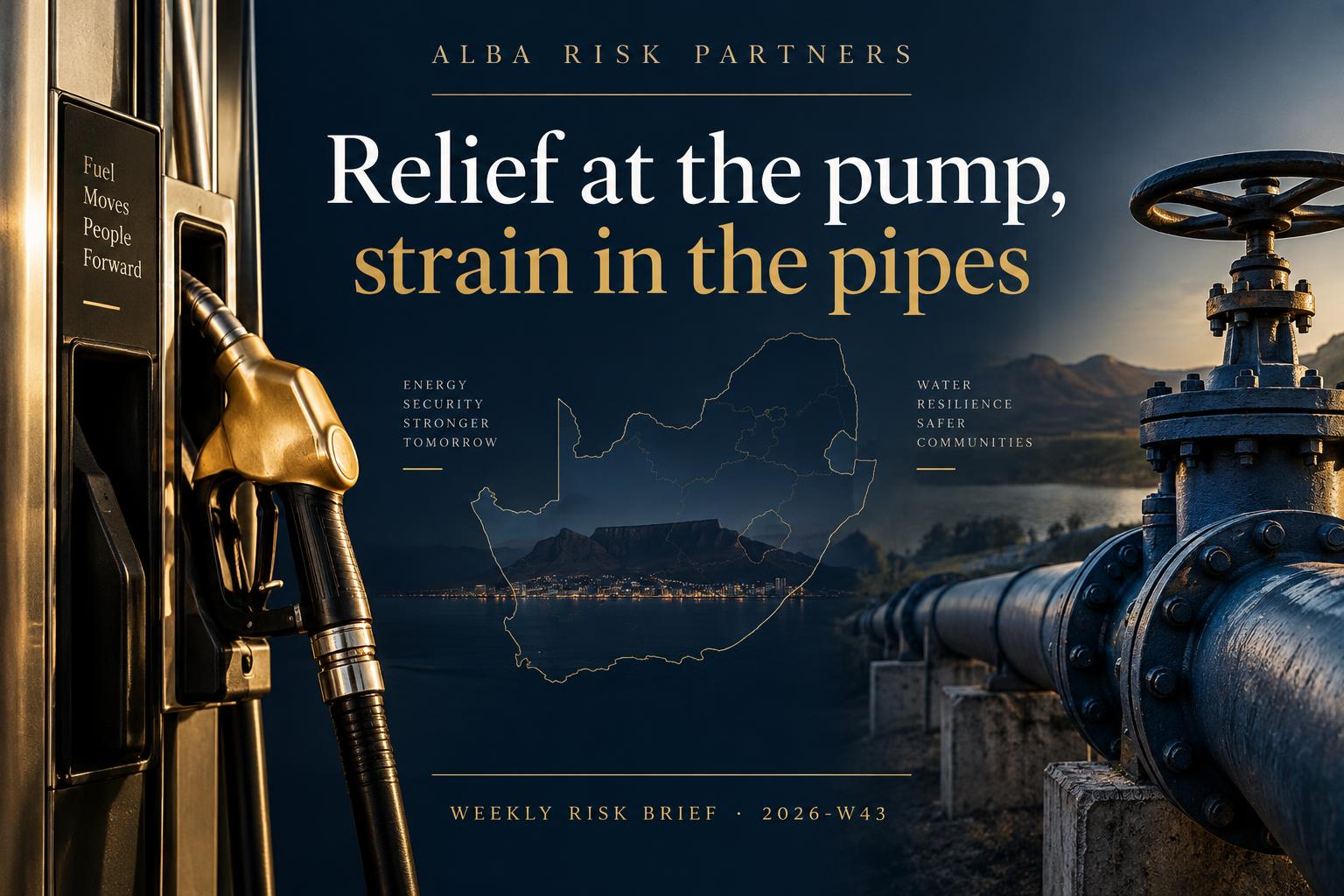
Weekly Risk Brief: Relief at the Pump, Strain in the Pipes (Week 43, 2026)
Steyn Mc Dowall · 29 October 2026
Treasury has found R10 billion for fuel relief and another R10 billion for El Niño, but the sharper risks this week sit outside the budget: software flaws that took websites offline, Ebola in a fourth African country and tap water that made children ill.
Each risk is classified by severity, reach and onset, with its direction of travel and risk transfer position.
The view ahead
Treasury has found R10 billion for fuel relief and another R10 billion for El Niño, but the sharper risks this week sit outside the budget: software flaws that took websites offline, Ebola in a fourth African country and tap water that made children ill.
The Medium-Term Budget Policy Statement showed public debt falling as a share of GDP for the first time in 17 years, which allowed Treasury to cut the general fuel levy by R1.50 a litre on petrol and R3 on diesel from 4 November to 1 December, with smaller cuts until 5 January, at a cost of R10 billion. A further R10 billion was placed in the contingency reserve against El Niño. Growth is still forecast at only 1.2 percent for 2026, and inflation rose to 4.5 percent in September while fuel prices sat at a record and were due to rise again in November. Away from the budget, critical flaws found by AI in PHP, a language used by an estimated 70 percent of websites, sent governments and businesses scrambling to patch, Nigeria reported its first Ebola case in more than a decade, and Bronkhorstspruit residents were told to stop using tap water.
We expect the levy relief to soften the pump price in November without reversing it, and we expect the real test to come when the full levy returns after 5 January. We expect the 4 November elections to proceed now that the ballot dispute is settled, with attention moving to campaign litigation, coalition talks in hung councils and service delivery in the metros. We expect Ebola to bring tighter screening and travel controls across the continent, and we expect Cape Town to learn in early November whether restrictions follow from 1 December. The risks that reach clients first are operational: patching discipline, safe water, a payroll rise for restaurants taking effect on 26 October and a rebid of HIV treatment contracts.
Risks at a glance
Severity is how hard the risk lands. Reach is how far it travels: contained to one sector, connected across several, or systemic across the economy. Onset is how soon it arrives: immediate, building over coming months, or long-range. Nothing this week is rated severe.
| Risk | Severity | Reach | Onset | Direction |
|---|---|---|---|---|
| CLI-01El Niño and the 2027 food price path | Major | Systemic | Building | Rising |
| HLT-04Ebola spreads across Africa | Major | Connected | Immediate | Rising |
| MAC-01Fuel and imported-inflation shock | Major | Systemic | Immediate | Stable |
| CLI-02Western Cape water restrictions | Moderate | Contained | Building | Rising |
| CYB-01Critical flaws in PHP web software | Moderate | Connected | Immediate | Rising |
| GOV-03Criminal infiltration of police and prosecution | Moderate | Systemic | Building | Stable |
| HLT-08HIV treatment contracts set aside | Moderate | Connected | Building | Stable |
| INF-03Public infrastructure delivery bottleneck | Moderate | Connected | Building | Stable |
| INF-04Contaminated tap water in Bronkhorstspruit | Moderate | Contained | Immediate | Stable |
| LAB-02Restaurant bargaining agreement extended to all employers | Moderate | Contained | Immediate | Stable |
| POL-01Local government elections on 4 November | Moderate | Connected | Immediate | Stable |
| MAC-02Public debt and the cost of credit | Moderate | Systemic | Building | Easing |
| GOV-09Metro funding and service strain | Minor | Connected | Long-range | Rising |
| HLT-02Mpox community spread | Minor | Contained | Building | Rising |
| POL-04Campaign litigation and supplier payment risk | Minor | Contained | Immediate | Stable |
Dates that will move the picture
- 26 Oct
- Restaurant bargaining agreement extension takes effectLAB-02
- Late Oct
- Water department runs Western Cape confirmatory modelCLI-02
- Week of 2 Nov
- Court hears supplier's R40 million claim against the ANCPOL-04
- 4 Nov
- Local government electionsPOL-01
- 4 Nov
- Fuel levy relief begins: R1.50 off petrol, R3 off dieselMAC-01
- 9 Nov
- Madlanga Commission public hearings resumeGOV-03
- 1 Dec
- Cape Town water restrictions possible from around this dateCLI-02
- 5 Jan
- Fuel levy relief ends, with smaller cuts from 1 DecMAC-01
Opportunities worth watching
A stronger fiscal base. Debt has fallen as a share of GDP for the first time in 17 years on stronger tax revenue, which has funded temporary fuel relief and a R10 billion reserve.
Tourism and vehicle sales. Business confidence, at 134.3, is still supported by new-vehicle trade and inward tourism linked to international sport events.
East African trade. South Africa and Uganda are working to remove trade barriers, and Kampala wants a long-delayed agreement on standards and trade facilitation finalised.
Risk register
Each card carries the risk, its category, severity, reach, onset, direction of travel and risk transfer position, together with the response we recommend.
- Insurable
- Three blocks. Cover readily placed in the local market.
- Partially insurable
- Two blocks. Cover available for part of the exposure, locally or internationally, with material exclusions.
- Not insurable
- One block. No insurance market responds. The exposure is managed, hedged or retained.
Major severity
CLI-01
El Niño and the 2027 food price path
- Category
- Climate
- Severity
- Major
- Reach
- Systemic
- Onset
- Building
- Direction
- Rising
- Insurance
- Partially insurable
Treasury has placed R10 billion in the contingency reserve for El Niño, which it expects to bring hotter and drier conditions that threaten farm output from late 2026 into 2027. The reserve signals how seriously the state takes the event but is not a commitment of relief to any farm or food chain. The wars in Ukraine and Iran have also disrupted fertiliser supply, adding to the cost of the planting window.
What we recommend
Stress-test input costs, crop volumes and food-linked pricing against a poor summer, and secure fertiliser supply early. Agree drought trigger points now, while cover and contracting options are still open.
HLT-04
Ebola spreads across Africa
- Category
- Health
- Severity
- Major
- Reach
- Connected
- Onset
- Immediate
- Direction
- Rising
- Insurance
- Partially insurable
Nigeria has reported its first Ebola case in more than a decade, making it the fourth African country affected by an outbreak described as the fastest spreading on record. Since cases were confirmed in the DRC in May, 4 646 people have died. Kenya has recorded nine infections linked to its first case this month. The strain kills about half of those infected and has no approved treatment or vaccine.
What we recommend
Review screening, travel rules and evacuation arrangements for staff moving through West, East and Central Africa. Check supply chains that depend on the affected countries.
MAC-01
Fuel and imported-inflation shock
- Category
- Macro and energy
- Severity
- Major
- Reach
- Systemic
- Onset
- Immediate
- Direction
- Stable
- Insurance
- Not insurable
Fuel prices reached a record this month and are due to rise again in November. Treasury will cut the general fuel levy by R1.50 a litre on petrol and R3 on diesel from 4 November to 1 December, with smaller cuts until 5 January, at a cost of R10 billion. Annual inflation rose to 4.5 percent in September from 4.4 percent, below the 4.7 percent economists expected.
What we recommend
Treat the relief as temporary and keep hedges and fuel escalation clauses in place. Plan margins for the full levy returning after 5 January.
Moderate severity
CLI-02
Western Cape water restrictions
- Category
- Climate
- Severity
- Moderate
- Reach
- Contained
- Onset
- Building
- Direction
- Rising
- Insurance
- Not insurable
Dam storage in the Western Cape Water Supply System stood at 73.8 percent, down 0.90 percentage points in a week, with consumption above target and another dry summer ahead. The national water department will run a confirmatory model at the end of October and into early November. Cape Town could then impose restrictions from around 1 December.
What we recommend
Confirm water continuity plans and on-site storage for Western Cape operations before the model reports. Prepare restriction-ready operating procedures now.
CYB-01
Critical flaws in PHP web software
- Category
- Cyber
- Severity
- Moderate
- Reach
- Connected
- Onset
- Immediate
- Direction
- Rising
- Insurance
- Partially insurable
AI has found critical vulnerabilities in PHP, a language used by an estimated 70 percent of websites, that could let attackers run malicious code and reach sensitive information. Governments and businesses abroad took websites offline while applying fixes, and South African hosting providers, including Afrihost, 1-Grid and Xneelo, are patching servers. The source reports patching, not confirmed local breaches.
What we recommend
Ask every hosting provider and web developer for written confirmation that the fixes are applied, and keep an inventory of your sites. Prepare incident response and data-breach notification steps.
GOV-03
Criminal infiltration of police and prosecution
- Category
- Governance
- Severity
- Moderate
- Reach
- Systemic
- Onset
- Building
- Direction
- Stable
- Insurance
- Partially insurable
The national police commissioner has returned to work after the president lifted his suspension, weeks after the National Prosecuting Authority withdrew the charges against him, which related to a police tender. The Madlanga Commission resumes public hearings on 9 November, after the elections. Matters before the commission remain allegations.
What we recommend
Keep screening counterparties and intermediaries for links to matters before the commission and record the basis of each decision. Expect enforcement capacity to stay stretched through the election period.
HLT-08
HIV treatment contracts set aside
- Category
- Health
- Severity
- Moderate
- Reach
- Connected
- Onset
- Building
- Direction
- Stable
- Insurance
- Not insurable
The High Court in Pretoria has declared the main contracts in the Health Department's R15.5 billion Aids drug tender unconstitutional and invalid. It set aside two contracts worth R12.63 billion for the combination pill taken by most HIV patients, finding that two winning bidders should have been disqualified at the outset and a third was unfairly shut out. The department has 120 days to reconsider eligible bidders.
What we recommend
Healthcare and pharmaceutical clients should map supply, stock and contract exposure through the rebid. Employers running HIV programmes should confirm stock arrangements.
INF-03
Public infrastructure delivery bottleneck
- Category
- Infrastructure
- Severity
- Moderate
- Reach
- Connected
- Onset
- Building
- Direction
- Stable
- Insurance
- Not insurable
Only 433 of the 2 549 government tenders advertised in 2025, or 17 percent, were awarded, while 279 were cancelled and 1 837 remain in procurement. Infrastructure South Africa blames incomplete feasibility studies, weak business cases and uncertain financing, and government has committed R600 million to project preparation. The Competition Commission is also building an AI tool to detect bid-rigging in tenders.
What we recommend
Carry delay as the base case in pipeline and revenue assumptions for public-sector work. Review bid conduct and teaming arrangements before submitting tenders.
INF-04
Contaminated tap water in Bronkhorstspruit
- Category
- Infrastructure
- Severity
- Moderate
- Reach
- Contained
- Onset
- Immediate
- Direction
- Stable
- Insurance
- Partially insurable
There were 408 cases of gastrointestinal illness between 7 and 18 October, mostly in children under four, with no deaths recorded. Tshwane's treatment plant supplied unchlorinated water from 24 September to 14 October after problems with its chlorine supplier, and tests found high levels of E. coli. Residents must not use tap water for drinking, cooking, washing or bathing, and tankers are supplying tested water.
What we recommend
Stop using municipal water in food, beverage, hospitality and healthcare processes in the area, and record when you did so. Confirm alternative supply and any contamination cover.
LAB-02
Restaurant bargaining agreement extended to all employers
- Category
- Labour
- Severity
- Moderate
- Reach
- Contained
- Onset
- Immediate
- Direction
- Stable
- Insurance
- Not insurable
The Labour Minister gazetted on 16 October an extension of the restaurant industry's collective agreement on wages and benefits to all employers, including those that did not sign it, taking effect on 26 October. The hospitality association Fedhasa estimates that payroll costs could rise by 9 percent and warns that small family-run restaurants may close.
What we recommend
Model payroll, pricing and staffing for 26 October, and check the scope of the extension and any exemption provisions. Suppliers to the sector should expect slower payment.
POL-01
Local government elections on 4 November
- Category
- Political
- Severity
- Moderate
- Reach
- Connected
- Onset
- Immediate
- Direction
- Stable
- Insurance
- Partially insurable
The electoral commission has confirmed that the ANC's 181 candidates in six municipalities meet the requirements, following the Constitutional Court ruling last week, so the ballot dispute is closed for now. A poll fielded from 10 August to 14 September has the DA 13.2 points ahead of the ANC in Johannesburg and on 52.6 percent in Cape Town against 23.6 percent. Polls measure sentiment, not outcomes, and the bill to regulate hung councils will not pass before the vote.
What we recommend
Plan for service disruption and restricted movement around 4 November, and for coalition negotiations in hung councils afterwards. Confirm riot and public disorder cover and the excess above the Sasria layer.
MAC-02
Public debt and the cost of credit
- Category
- Macro and energy
- Severity
- Moderate
- Reach
- Systemic
- Onset
- Building
- Direction
- Easing
- Insurance
- Not insurable
Public debt has fallen as a share of GDP for the first time in 17 years, helped by stronger tax revenue. Growth is forecast at only 1.2 percent in 2026, and business groups say fiscal stability must now turn into delivery. Higher debt-servicing costs are still cited as a drag on sentiment, and the chamber of commerce's confidence index slipped to 134.3 from 135.1.
What we recommend
Keep covenant headroom and floating-rate exposure under review. Do not assume fiscal improvement alone will lower your borrowing costs.
Minor severity
GOV-09
Metro funding and service strain
- Category
- Governance
- Severity
- Minor
- Reach
- Connected
- Onset
- Long-range
- Direction
- Rising
- Insurance
- Not insurable
Treasury is phasing out the Public Transport Network Grant over three years and redirecting money to passenger rail, which Cape Town says threatens a MyCiTi network that has grown 68 percent since 2021. In Tshwane, informal settlements have more than doubled from 220 in 2020 to 502 in 2026, and the city spends over R1.5 billion a year on services against R3 billion allocated for relocation.
What we recommend
Review commuter and logistics dependence on municipal services in Cape Town and Tshwane. Expect service pressure to continue regardless of the election result.
HLT-02
Mpox community spread
- Category
- Health
- Severity
- Minor
- Reach
- Contained
- Onset
- Building
- Direction
- Rising
- Insurance
- Partially insurable
South Africa has recorded four new mpox cases, bringing the total to 26 since January. The Western Cape accounts for 18, and 16 of those are linked to local transmission. Twenty-five of the 26 patients are men aged between 23 and 50. Authorities urge anyone with a rash, fever, headaches or swollen lymph nodes to seek care and close contacts to monitor symptoms for 21 days.
What we recommend
Brief staff on symptoms and on 21-day contact monitoring, and confirm how health cover responds. Keep absence and return-to-work rules current.
POL-04
Campaign litigation and supplier payment risk
- Category
- Political
- Severity
- Minor
- Reach
- Contained
- Onset
- Immediate
- Direction
- Stable
- Insurance
- Partially insurable
A marketing supplier has asked the Gauteng High Court to compel the ANC to pay R40 million it says is owed for 2019 election work, and wants the party's incoming electoral commission funding frozen. The hearing is due next week, and the claim is untested. Separately, the DA has been ordered to remove billboards linking three eThekwini officials to the water tanker mafia, after the officials called them defamatory.
What we recommend
Suppliers to campaigns should seek deposits or payment security in advance. Anyone placing political advertising should review defamation exposure before publication.
Where insurance carries the load
Little of this week's register transfers cleanly: no risk is rated fully insurable, eight sit in the middle and seven fall to the balance sheet. Cyber cover answers breach response costs, extortion and business interruption after a security event, but insurers commonly condition it on timely patching, so a known PHP flaw left open can put a claim in question. Infectious-disease extensions have been written out of local policies, so Ebola and mpox are questions for medical schemes, travel and evacuation cover, not business interruption. Sasria remains the sole route for riot and public disorder losses around the 4 November elections. Drought runs to parametric structures placed offshore, so the El Niño reserve is a sign of the state's concern, not a substitute for cover. Contamination of a public water supply is not a loss at the client's own premises, and a utilities extension answers a physical supply failure rather than water that is available but unsafe. Media liability and legal expenses cover answer defamation claims and defence costs, though any fine, including one under competition law, is uninsurable, because cover for a penalty offends public policy.
The seven risks no market will take have to be managed, and each needs a different tool. Fuel is the one the budget has just moved: the levy cut runs from 4 November to 1 December with smaller reductions to 5 January, so clients should keep hedges and escalation clauses in place and plan margins for the full levy returning. Public debt and credit costs are improving but are not yet in the price of borrowing, so covenant headroom and floating-rate exposure should be reviewed before any rate benefit is assumed. For Cape Town water the answer is storage, recycling and restriction-ready procedures, settled before the confirmatory model reports.
The infrastructure bottleneck and metro funding pressure are slower, so pipeline and revenue assumptions for public-sector work should carry delay as the base case, with milestone payments and delay clauses written into contracts.
Severity: severe, major, moderate, minor, limited. Reach: contained, connected, systemic. Onset: immediate, building, long-range. Ratings are analyst judgements. Matters before the courts are allegations until determined. This brief is general information and not advice on any specific decision.
Share this article